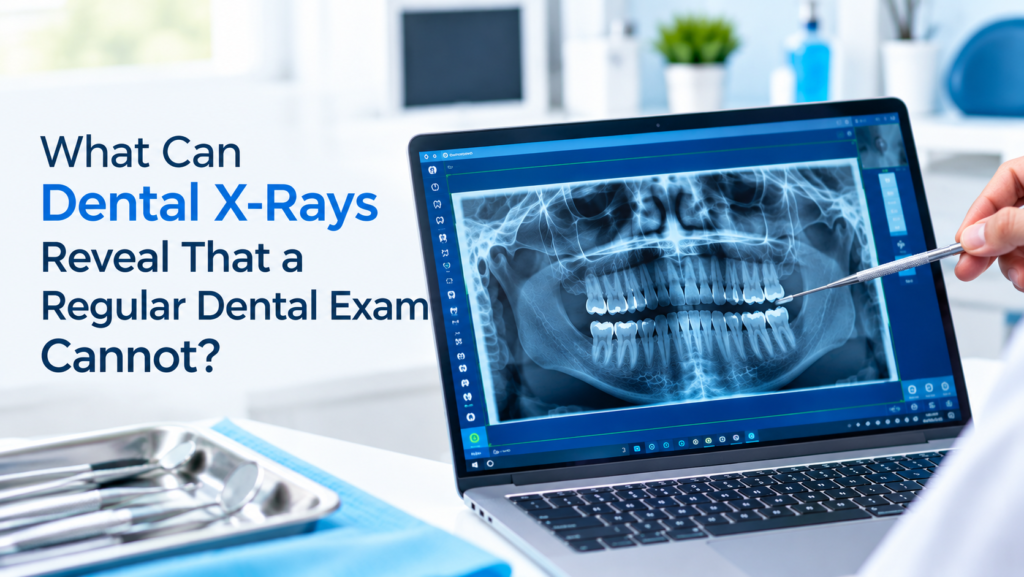
Regular dental exams allow your dentist to monitor your teeth, gums and mouth. However, some dental problems develop in areas that are difficult to see during a visual examination. X-rays of the teeth give more information which can be useful in discovering these concealed concerns. Knowing what dental X-rays can tell you may help you feel more at ease about your routine dental visits. Whether it’s between your teeth or around the root, these pictures can enable your dentist to assess your oral health and advise you on the proper treatment you require.
What Is the Difference Between a Dental Exam and Dental X-Rays?
A dental exam and dental X-rays are mutually supporting, but different. When you visit your dentist for an exam, your dentist examines visible areas of your mouth and for signs of dental issues. X-rays give information about structures under the surfaces of the teeth and other parts that aren’t detectable just by visually examining the tooth.
Dental exam | Dental X-rays |
Checks visible tooth surfaces for damage and decay | Helps identify decay between teeth and beneath some existing restorations |
Evaluates gums for inflammation, bleeding, and recession | Can show changes in the bone supporting your teeth |
Checks existing fillings, crowns, and other dental work | Provides information about tooth roots and surrounding structures |
Helps identify visible cracks, wear, and other concerns | May reveal impacted teeth and certain hidden dental problems |
Allows your dentist to examine your bite and oral tissues | Provides additional diagnostic information when clinically appropriate |
Your dentist might take a dental X-ray if necessary for evaluating a concern or treatment. Not all visits to the dentist necessitate new pictures.
What Can Dental X-Rays Reveal That a Regular Dental Exam Cannot?
Dental X-rays may uncover a number of issues that might not be apparent when examining the mouth routinely. The findings will depend on the kind of X-ray that is taken and the condition being evaluated.
1. Cavities Between Teeth
Sometimes cavities can occur between adjacent teeth, where a visual inspection may not be accurate. Regular brushing and flossing may not be enough to get to these areas.
Dental X-rays, especially biting images, may assist in detecting dentistry between teeth before it grows to be more extensive. If a filling or other treatment is necessary, early detection will enable your dentist to evaluate the affected area.
2. Decay Beneath Existing Fillings or Crowns
Dental fillings and crowns are used to fill and restore damaged teeth; however, sometimes decay can still be formed around the edges of the filling or crown. The area may not be visible during a typical dental checkup if it’s just a small portion or is located behind the tooth.
X-rays can provide additional information about possible decay around existing restorations. Your dentist will examine the X-rays and your symptoms and clinical exam to determine treatment.
3. Bone Loss Around Teeth
The bone and gum tissues that support teeth are vital to their health. Over time, gum disease can injure these support tissues without the victim being aware of any discomfort.
The X-rays of the teeth can be used to identify changes in the bone around the teeth. Along with the gum measurements and examination, this information allows your dentist to assess if there may be periodontal disease and if additional treatments are required.
4. Problems Around Tooth Roots
The roots of the teeth grow below the gum line and can’t easily be seen when you look at the teeth. There might be no external signs of problems affecting the root or surrounding tissues.
Dental x-rays may be used to help determine any changes around tooth roots, such as some infections, bone changes and abnormalities near the root tip. A dentist might use X-rays as part of the checkup if a tooth is painful or tender over an extended period of time to help identify the cause.
5. Impacted or Developing Teeth
Some teeth do not emerge into their expected positions. Wisdom teeth are a common example, while other teeth may remain trapped beneath the gums or develop in an unusual direction.
Dental X-rays can show the position of impacted teeth and provide information about their relationship to neighboring teeth. This is particularly useful when evaluating wisdom teeth, investigating delayed tooth eruption, or planning certain dental procedures.
6. Hidden Dental Infections
Sometimes, a dental infection can spread to the tissues around the root of a tooth or into the bone around the tooth. Some infections may not have apparent signs and symptoms at first, but swelling, pain or tenderness can be a sign of a problem.
X-rays might show changes in the bone or tissues around the root, which could indicate a problem. Some infections do not appear on an X-ray, however, all of these factors, along with dentist symptoms and examinations, may be taken into account.
7. Certain Cysts and Other Abnormalities
A routine check-up may not detect some abnormalities in the jaw bone or around the roots of the teeth. When taking X-rays, the dentist may be able to see areas that are unusual and deserve additional attention.
When something is abnormal, it does not necessarily mean that you have a serious disease. Your dentist will examine its look and position, and, when necessary, refer you to a specialist or suggest further imaging or monitoring.
Can Dental X-Rays Detect Problems Before You Feel Pain?
Yes. Sometimes, dental changes that might indicate a dental issue can be seen on dental X-rays before you notice any symptoms. Decay between teeth, bone loss or some changes around tooth roots can occur without pain, for instance.
However, not all dental conditions can be seen with X-rays, and a normal X-ray doesn’t mean that all areas of the mouth are normal. There are some problems which can be determined by a physical exam and others that need further testing.
Your dentist will be able to put these all together and make recommendations for your dental care during regular checkups. Early detection can provide the opportunity for avoiding some problems becoming more serious or requiring lengthier treatment.
What Types of Dental X-Rays May Your Dentist Recommend?
Different dental X-rays provide different views of your teeth and supporting structures. Your dentist selects the type according to your symptoms, dental history, and the information needed.
Type of dental X-ray | What it helps evaluate |
Bitewing X-rays | Cavities between teeth and the bone level around teeth |
Periapical X-rays | The entire length of a tooth, including its root and surrounding tissues |
Panoramic X-rays | A broad view of the teeth, jaws, and surrounding structures |
Specialized dental images | Specific dental concerns that require additional diagnostic detail |
Your dentist may recommend a particular image rather than taking every type of X-ray. The goal is to obtain the information necessary for an accurate assessment while avoiding unnecessary exposure.
Are Dental X-Rays Necessary at Every Dental Checkup?
No, dental x-rays aren’t mandatory at every visit. Requirements for imaging vary based on oral health, past dental x-rays, a history of tooth decay, gum disease, oral symptoms, and risk of oral disease.
For instance, if someone has new tooth pain, they might need an X-ray to look into the issue but if a patient has a stable oral health history, they may not need extra images at that visit.
The amount of radiation in modern digital dental X-rays is relatively low. They should be recommended by your dentist if they provide enough diagnostic information to justify the exposure and if necessary, steps should be taken to reduce unnecessary radiation.
Talk to your dentist if you recently had dental X-rays at another dentist’s office. You can use previous images and these may be helpful to save the need to repeat previous images.
What Happens After Your Dentist Reviews Your X-Rays?
Your dentist will then analyze your photos and compare the findings with the information from your oral examination. If the images indicate a concern, your dentist will let you know what this might signify and discuss further action steps.
Depending on the findings, these steps might include:
- Surveillance of an area that is not currently being treated.
- Educating patients on possible filling options for known cavities.
- Assessing the health of the gum when bone changes occur.
- Evaluating a tooth that may have issues with its roots.
- Ordering more imaging tests if needed and referring you to a specialist if needed.
Not every finding requires immediate treatment. Your dentist will consider the overall condition of your mouth, the severity of the concern, and your individual dental needs when developing a treatment plan.
How Can You Prepare for a Dental Exam?
Preparing for a dental exam can help you make the most of your appointment. Before your visit, consider the following steps:
- Share your dental history: Tell your dentist about previous dental treatments, cavities, gum problems, or other oral health concerns.
- Mention any symptoms: Explain if you have tooth sensitivity, pain when chewing, swollen gums, or other changes in your mouth.
- Bring previous dental X-rays: If you have recent images from another dental office, let your dentist know. They may help determine whether new X-rays are necessary.
- Ask about recommended imaging: If your dentist suggests dental X-rays, ask what they will help evaluate and why they are appropriate for your situation.
- Discuss your medications and health changes: Share relevant medical information that may affect your dental care.
A little preparation helps your dentist understand your needs and make informed decisions about your examination. It also gives you an opportunity to ask questions and better understand your oral health.
Closing Insights
Dental X-rays provide valuable information that a regular dental exam may not reveal, including cavities between teeth, changes around tooth roots, bone loss, and impacted teeth. When used alongside a clinical examination, they help your dentist understand your oral health and recommend appropriate treatment when needed. The need for X-rays depends on your dental history, symptoms, and individual risk factors.
If you are due for a checkup or have concerns about your teeth, Family Practice Dentistry offers dental exams and X-rays in Kokomo, Indiana. Contact Dr. Kevin J. Welch at 765-453-0085 to schedule an appointment and discuss your dental care needs.