
Dental visits aren’t time for a quick inspection of your teeth. A dentist will listen to your concerns, take a history of your dental and medical conditions and examine your mouth and may take an X-ray or other diagnostic tests to better understand the problem. Then, the dentist can describe the issue and discuss potential treatment options that are right for you. Depending on your visit’s purpose, you’ll receive different care. A routine appointment could be preventive treatment, while a toothache, tooth decay, broken tooth or infection could require an in-depth evaluation and treatment. Knowing about the dentist’s process and how they assess and treat problems in the mouth will make an appointment easier to understand and will help you feel more prepared.
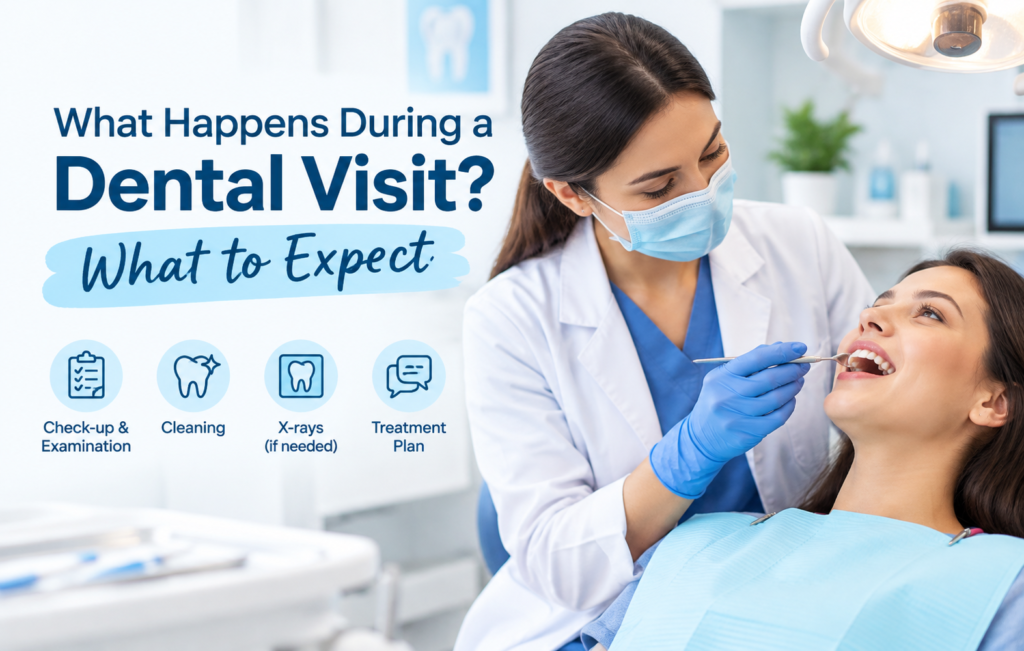
What Happens First During a Dental Visit?
Typically, the appointment begins by chatting with someone. Your dentist may ask why you made the appointment and if you have seen any changes in your teeth, gums or mouth.
Be prepared to discuss:
- Tooth pain or sensitivity
- Bleeding or swollen gums
- Difficulty chewing
- A chipped or cracked tooth
- A loose tooth
- Changes in your bite
- Persistent bad breath
- Previous dental treatment
Your medical history can also be important. Notify your dentist of any medication, allergies, health changes and previous dental treatments. This enables the dentist to have a better picture of how you will be before you come in for the exam.
How Does a Dentist Examine Your Teeth?
The dentist will discuss your concerns and then conduct a dental exam. This means examining your teeth, gums and the rest of your mouth for any possible issues.
The dentist can look for:
- Tooth decay
- Gum inflammation
- Cracked or damaged teeth
- Worn fillings or crowns
- Changes in your gums
- Problems with your bite
- Areas that may require additional evaluation
The exam is not done to check on the condition you came in to see us for, but to find out what is happening in your mouth.
When Are Dental X-Rays Needed?
You can’t always see all the dental issues at a routine checkup. Your dentist may suggest dental X-rays in these cases.
X-rays can give information on the following areas:
- Between the teeth
- Around tooth roots
- Beneath certain restorations
- Supporting bone
- Areas where decay may not be visible
X-rays are not necessarily required at each appointment. The decision to perform imaging is individualized depending on your symptoms, dental history, age and oral health.
Family Practice Dentistry uses digital X-rays when appropriate as part of its diagnostic and dental technology.
How Does a Dentist Find the Cause of a Dental Problem?
Sometimes a symptom doesn’t reveal to the dentist exactly what is causing a problem. For instance, a toothache could be a symptom of a cavity, infection, crack, gum issues or even other conditions. Sensitivity can also be due to other causes.
The dentist takes into account a number of factors, such as:
- The symptoms you have or are experiencing.
- The duration of time you have had them in your possession.
- What helps to make the symptoms better or worse.
- What the dentist observes during the examination.
- What dental X-rays or other diagnostic information show .
When combined, these details will assist the dentist in identifying the possible cause of the issue and if it requires treatment.
How Is the Right Dental Treatment Chosen?
After the dentist knows what the problem is, he or she will be able to discuss the proper treatment. Treatment recommendations vary based on severity of the issue, tooth health, oral health and if the tooth can be restored.
Treatment may range from:
- Professional dental cleaning
- Dental fillings
- Dental bonding
- Crowns
- Root canal therapy
- Tooth extraction
- Bridges
- Dentures
- Dental implants
- Invisalign®
- Teeth whitening
- Veneers
- Emergency dental care
Not all dental issues need extensive treatment. However, in a few situations, preventive care or monitoring may suffice.
What Does Actual Dental Treatment Involve?
The process varies depending upon the type of treatment being performed.
Dental Fillings
When a tooth has decay that is too large to be filled, the dentist will extract the decayed area and replace it with a filling.
Root Canal Therapy
Root canal treatment might be considered if the inside of a tooth is infected or swelled. The dentist will remove the damaged tissue, clean the root canals, and seal the tooth.
Crowns
A crown can be used if a tooth has been weakened or severely damaged. The restoration covers the tooth and helps restore its function and appearance.
Tooth Extraction
Sometimes, an extraction may be indicated when a tooth is not capable of being successfully restored. Your dentist will examine the tooth, and decide if there are other possibilities.
Replacement of Missing Teeth
Depending on your oral situation, and your individual needs, you could replace missing teeth with bridges, dentures, or dental implants.
The selected treatment should depend on the condition of your teeth and what is suitable for you.
Does the Dentist Explain Treatment Before Starting?
Yes. One should know what is recommended prior to starting treatment.
You can ask:
- What is causing the problem?
- What is the reason for this treatment?
- Is there anything else that might be done?
- Is the tooth reparable?
- How many appointments will be required?
- What can I expect to experience following treatment?
- What will be the consequences of not following the treatment?
Dr. Kevin J. Welch, DDS, at Family Practice Dentistry, explains dental issues to patients and offers treatment suggestions so that the patient understands what is going on before making a decision on care.
How Is Patient Comfort Considered During Treatment?
Some people get anxious about dental work, particularly if they have a bad experience in the past. Let your dental team know if you are worried or nervous about discomfort. They can explain the procedure and let you know what you may experience during treatment. Local anesthesia can be used for certain procedures where the area being treated needs to be numb. The type of comfort measures used depends on the procedure and the patient’s individual needs.
What Happens After Dental Treatment?
Your dentist may give you directions to take care of the treated area following your visit.
Depending on the procedure you may be given information on:
- Eating and drinking
- Brushing and flossing
- Temporary sensitivity
- Caring for a restoration
- Follow-up appointments
- Additional treatment
By following these instructions you will be able to take care of your teeth after treatment and know when to call the dental office if you are concerned.
What Does Dental Care Look Like at Family Practice Dentistry?
Family Practice Dentistry in Kokomo offers dental services for general, cosmetic, restorative, laser, and emergency care. This means that, depending on the needs of the patient, the type of treatment may vary. A checkup appointment could be for patients who need preventative care, or for those who have tooth damage, infection, missing teeth or an urgent dental situation.
Dr. Kevin J. Welch, DDS, has over 20 years of dental experience. When necessary, the practice also leverages technology like digital X-rays and lasers. The basic process remains straightforward: understand the concern, evaluate the mouth, determine what is causing the problem, explain the available options, and provide appropriate care.
What May Make Family Practice Dentistry Different?
All dental practices are unique in the way they treat patients. Family Practice Dentistry isn’t just about a single procedure, but is a combination of multiple procedures all under one roof.
Individualized Treatment
Not all patients with similar symptoms will require the same treatment. Recommendation may depend on the state of the tooth and any prior dental treatments, oral health, and other factors. Therefore, treatment will be determined by the individual’s condition.
Different Types of Dental Care
There may be changes in dental needs over time. A patient might require preventive care now and restorative treatment at a later time. The practice provides general, cosmetic, restorative, laser and emergency dental services, which can be used to address various dental issues.
Modern Dental Technology
A visual exam might not reveal information that can be seen from a digital x-ray. Laser technology can also be used for some dental treatments. These are integrated where suitable to the patient’s treatment.
Experience and Continuing Education
Dr. Welch has been in practice for over 20 years and has completed his dental education during his practice.When considering various treatment options and addressing a variety of dental issues, experience can be invaluable.
Clear Communication
Sometimes there are multiple options for dental treatments. When coming across a recommendation, it can be beneficial to know why to make an informed decision about the care given. Explanation of findings, why treatment might be necessary, and what patients can expect is emphasized.
Care Beyond the Procedure
When a dentist appointment is over, it’s not necessarily over. Follow-up care, preventive recommendations, and regular examinations can help monitor the condition of your teeth over time. The continuous method can be significant to your oral health.
When Should You See a Dentist?
It’s not necessary to have intense pain to make a visit.
If you notice:
- Persistent tooth pain
- New or worsening sensitivity
- Swollen gums
- Bleeding gums
- A broken or cracked tooth
- Pain when chewing
- A loose tooth
- A lost filling or crown
- Facial or mouth swelling
- Another unusual change in your mouth
Seek immediate medical help if you find it difficult to breathe or swallow, and there’s severe swelling of the mouth and face.
What Can You Expect From Your Dental Visit?
There is a general order to a dental visit, but the treatment will depend on what your dentist discovers. The dentist takes the time to listen to your concerns, looks at your teeth and gums and if necessary, uses your X-rays or other information to determine what may be causing the problem and tells you about the possible treatment options. Family Practice Dentistry in Kokomo provides preventive, restorative, cosmetic, laser and emergency dental services according to the patient’s needs. It can help you feel more prepared and provide you with a greater understanding of why a certain treatment might be recommended.